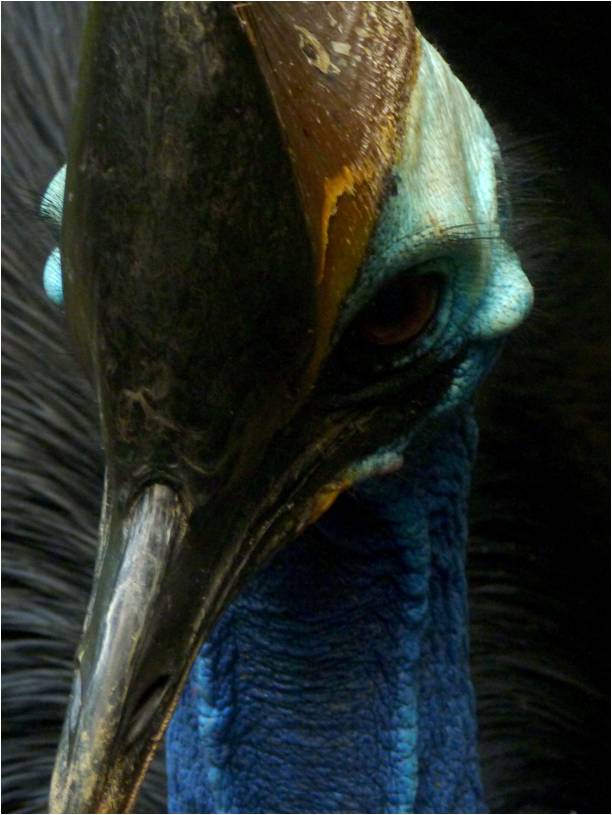
The double-wattled cassowary is one of those perfect living proofs of evolution: look at one, and you have no trouble believing that birds evolved from dinosaur-like ancestors. The only difficulty you might have is in believing that they’ve evolved very
much…

The double-wattled cassowary lives in Australia—or, at least, it is trying to live there. Much of its habitat (rainforests, for the most part) is being destroyed or subdivided by human development, and, while it is not currently listed as a threatened or endangered species, that designation could change.
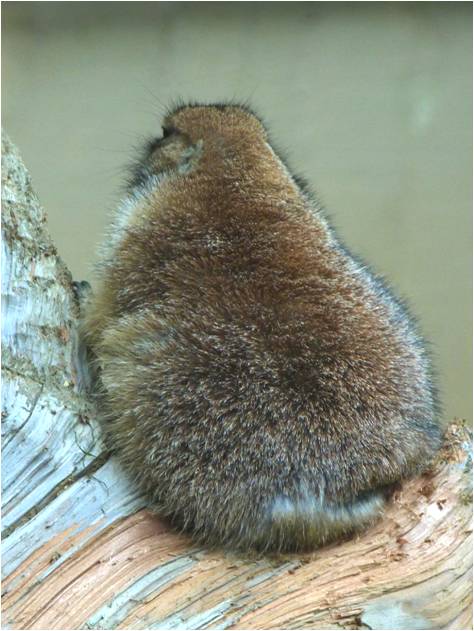
The cassowary’s situation is not unique. The number-one cause of extinctions worldwide is habitat loss and degradation, and the majority of that destruction and degradation is due, directly or indirectly, to human activities. (Polar bears and pikas are just two of the species whose habitats are disappearing because of global climate change, a process initiated and increased by human behaviors [for more information on climate change, see these sites from the
Worldwatch Institute, the
Union of Concerned Scientists, and the
World Wildlife Fund].)
Initially, I considered doing profiles on every animal at the zoo whose habitat is threatened by human activity—and then I realized I’d be profiling virtually every animal there. Of course, some species are doing well in the wild, and some animals whose populations were low are now recovering (often thanks in part to zoo
“Species Survival Plans”). But many species are threatened or endangered, and habitat loss is often a factor contributing to, if not causing, their situations.
To make sure that you’re suitably touched by their plight, I’ll give you one more example of an at-risk animal, this one actually listed as endangered. It’s one of those species referred to by scientists (or at least the ones I hang around with) as “charismatic macrofauna”: a big cute animal that everyone can like and feel sorry for—the kind that are often used to get people to care about threatened ecosystems, since few very people become teary-eyed at the sight of an endangered slime mold, no matter how important it may be to an ecological community.
My example is the red panda:

Cute, right?
Although they’re more closely related to raccoons than bears, red pandas, like giant pandas, live in bamboo forests (although the ranges of the two species only partially overlap). Also like giant pandas, red pandas’ habitats are disappearing. Logging and other human-development activities within their forests not only destroy their habitat outright but indirectly alter it: the disturbances that these human actions create lead to changes in the structure and composition of the forests. For example, activities that affect the soil and increase erosion can lead to changes in the community of tree species, since some trees’ roots may be less able to support them in loose or shallow soil, or because these changes in soil can allow opportunistic species to enter the environment and outcompete the original species. That’s one of the ways that red pandas’ homes, along with those of so many other species, can disappear.

I’m not mentioning all of this simply to be depressing. After all, some of these species may yet be capable of adapting to changing conditions—although, depending on whether or not that includes overcoming their fear of humans, their adaptations could lead to all sorts of new problems for them and us. But I do think it’s worth remembering that we destroy habitats for all kinds of different reasons: to build sub-suburban homes, to clear land for coffee and other farming, to get rid of our garbage, to build more power plants or mine more coal or drill more oil to satisfy our insatiable demand for energy. Mind you, I like my espresso as much as the next person (or probably much more than them), and I certainly make enough use of my laptop and digital camera. I just think it doesn’t hurt, from time to time, to consider all of the resources that we consume on a daily level, from electricity to gas to water to food, or to spend a few moments finding out where our old outdated laptops or cellphones or iPods will go when we’re done with them. In doing so, we can feel less guilt and take more pleasure in looking at red pandas and other adorable animals. And we can feel better about the slime molds, too. Even if we don’t want to look at them.