
Showing posts with label frog. Show all posts
Showing posts with label frog. Show all posts
Tuesday, November 6, 2012

Monday, August 6, 2012
Prism Break

The first kind of photography I learned to do all the way through, from taking the photos to developing the film to printing the pictures, was black-and-white photography, and for a while in college, when I had regular access to darkrooms, I was—maybe not obsessed—but certainly very taken by it. When I got into digital photography I felt I had to relearn how to use color in compositions.
Now I’m relearning how great it can be to leave color out.

I’d forgotten how much fun black-and-white photography is. I’d forgotten too how it lets you focus on texture and shape and portraiture and drama in a way that can occasionally get cluttered up by color.
For example, when photographing the howler monkey with her new(ish) baby, the absence of color helps me better frame their tender moments.


The absence of color makes the movements of the giant Pacific octopus, Pandora, as startling, sinuous, and striking as they are in real life.

It lets me enjoy the silky, liquid texture of a poison-dart frog without being distracted by its brilliant color.

I wish I could be more articulate, or more profound, but far more talented photographers than I have already done so. Suffice to say that it’s always nice to be reminded, yet again, that there are an infinite number of ways of seeing the world.
I recognize that not everyone responds to darkroom lights and fixative fumes as if they were memory- and perception-inducing madeleines. But have there been news ways in which you too have discovered the natural world?

{A note: I do write all text and take all pictures. Please do not reproduce either without my permission.}
Monday, June 25, 2012
The Frog Game: A New Player in Town

This weekend the open pond within the zoo was full of frogs: teeming with fat, half-grown tadpoles that pocked the surface with their carnivorous lunges at water-bugs, and the edges of lily pads and reed-beds lumpy with the bronze-green bodies of adults who floated, splay-legged, their dazed expressions suggesting too much time spent in the dazzling heat of the sun.
Perhaps the heat had addled their minds, or at least their usually well-honed sense of self preservation, because they showed no fear—or even awareness—of the many early-morning photographers clustering around their pond.

To play the frog game under these circumstances felt unsporting, so I didn’t bother to count the number of numbed amphibians gazing blankly past me. I soon discovered, however, that not everyone involved in the game was likely to be as generous: for there, right by the reeds—right there in the open, in broad daylight—was a really big snake!

That’s right: not a zoo-approved snake, but a wild one, a reptilian free agent, sitting (er, coiling) there like a wolf among the sheep. And the frogs weren’t doing a damn thing!
Maybe they feared drawing more attention to themselves by moving. But I can’t see how it was safer to stay within lunging distance of a huge predator… And these frogs really did look a bit stunned, like unsteady college kids after a night of binging; I can’t believe that all of them were aware of the snake and simply practicing a strategy of stealth.
But I can’t blame them for being unprepared. Probably the frogs assumed—as I had—that all the loose and brazenly displaying serpents were hanging out along the Appalachian Trail, not sunning themselves in the middle of the National Zoo.
Whatever the reason for their paralysis/torpor, I wasn’t about to stick around and see anybody get eaten.
It’s a dangerous game they’re playing.
Perhaps the heat had addled their minds, or at least their usually well-honed sense of self preservation, because they showed no fear—or even awareness—of the many early-morning photographers clustering around their pond.

To play the frog game under these circumstances felt unsporting, so I didn’t bother to count the number of numbed amphibians gazing blankly past me. I soon discovered, however, that not everyone involved in the game was likely to be as generous: for there, right by the reeds—right there in the open, in broad daylight—was a really big snake!

That’s right: not a zoo-approved snake, but a wild one, a reptilian free agent, sitting (er, coiling) there like a wolf among the sheep. And the frogs weren’t doing a damn thing!
Maybe they feared drawing more attention to themselves by moving. But I can’t see how it was safer to stay within lunging distance of a huge predator… And these frogs really did look a bit stunned, like unsteady college kids after a night of binging; I can’t believe that all of them were aware of the snake and simply practicing a strategy of stealth.
But I can’t blame them for being unprepared. Probably the frogs assumed—as I had—that all the loose and brazenly displaying serpents were hanging out along the Appalachian Trail, not sunning themselves in the middle of the National Zoo.
Whatever the reason for their paralysis/torpor, I wasn’t about to stick around and see anybody get eaten.
It’s a dangerous game they’re playing.
{A note: I do write all text and take all pictures. Please do not reproduce either without my permission.}
Tuesday, July 5, 2011
Wild Wildlife: The Score


{A note: I do write all text and take all pictures. Please do not reproduce either without my permission.}
Wednesday, April 13, 2011
The Frog Game

Earlier this week I had the opportunity to stroll around the campus of the National Labor College on beautiful, unnaturally warm day. I photographed the flowers, searched for the birds I could hear trilling in the trees, and wandered by the marshy pond, where I played the frog game.
Maybe you’ve played it, too: you’ll be walking by a stream or creek or pond—any body of water with some reeds or grasses growing along the banks—and suddenly you’ll hear an “Eeeeeeep!” and a splash—and you’ll know you’ve lost the frog game. –Because, you see, the frog has seen you, but you have not seen the frog.
So I spent a fair amount of time walking quickly but stealthily along the bank, trying to spot the frogs basking among the reeds before they saw me and, with a scream, threw themselves into the concealing water. I was somewhat successful, although I hadn’t brought along a camera with a sufficiently powerful zoom to document my triumphs. Still, I have my memories.
{A note: I do write all text and take all pictures. Please do not reproduce either without my permission.}
Thursday, February 24, 2011
One Good Shot: Mossy Frog
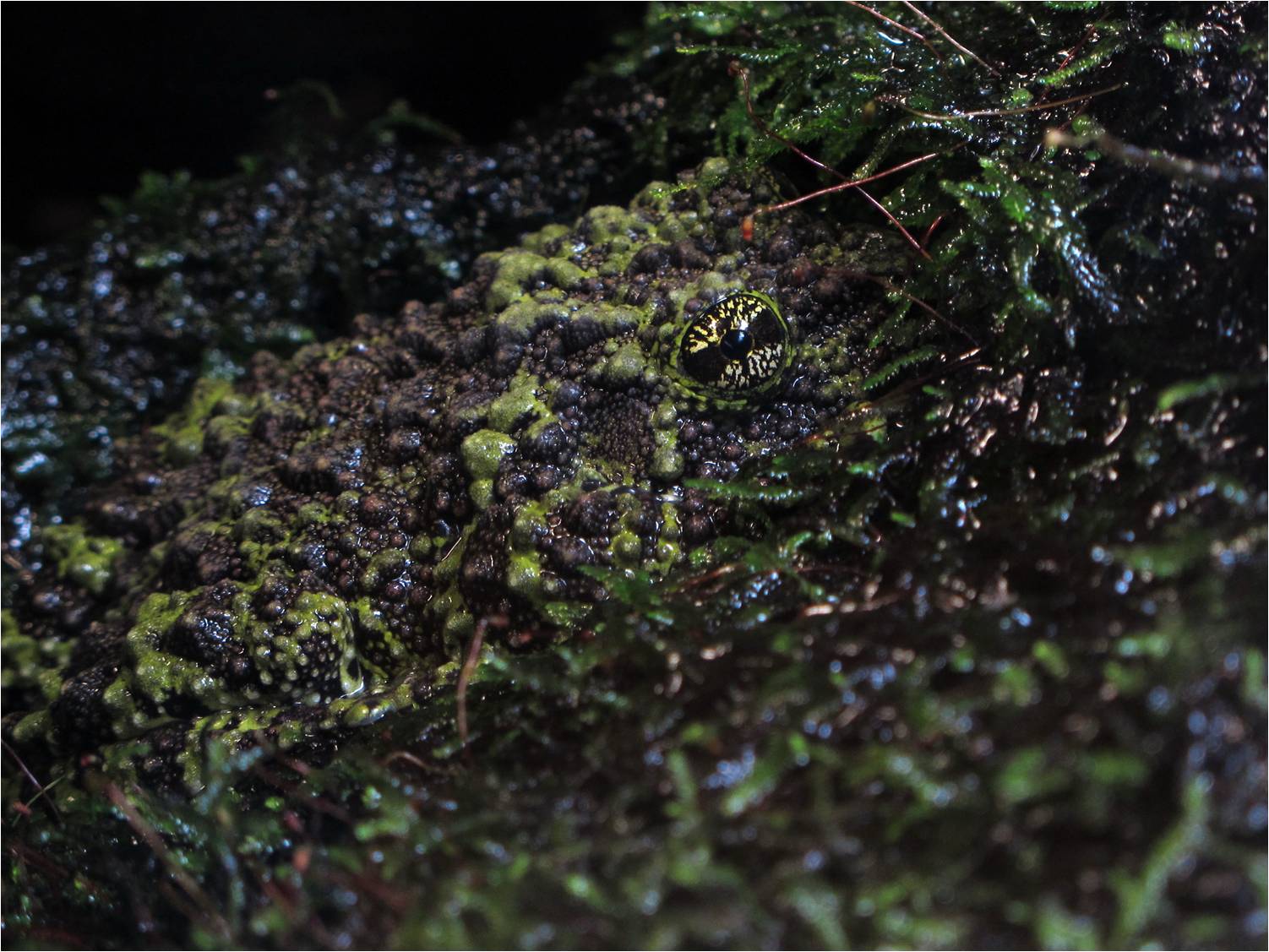
As I mentioned recently, there are people who approach the animals in the Reptile House as if they were part of a game called Find the Animal and Then Dismiss It. But even if you don’t see much opportunity to observe behavior with some of the less-active reptiles and amphibians, it’s worth a moment’s time simply to admire the perfection of their camouflage and the skill with which they elude our, and others’, eyes.
{A note: I do write all text and take all pictures. Please do not reproduce either without my permission.}
Saturday, November 6, 2010
Wild Wildlife

I admit, I didn’t see the mantis myself. Instead, I saw a man holding his young son up as they both peered into the grasses growing alongside the path to the “Great Cats” enclosures. I was curious but didn’t want to pry—until I heard the little boy exclaim loudly to the world, “It’s a PRAYING MANTIS!!!”

Everyone else, focused on large mammals, paid no attention, and in a moment the boy and his father, too, moved on. But I stopped to observe the mantis as it made its way up and around various grasses, sometimes clinging, sometimes climbing, depending on the force of the wind that tossed the stems hither and thither.

Nor did I see the first of these three little frogs, balancing like sentinels on the lily pads of the water around Lemur Island—my mother noticed them. (She’s always had a fondness for frogs, in spite of a traumatic childhood encounter when, as she tried to chuck one under the chin, it bit her.)

But I did see this squirrel, gnawing and chittering on a tree behind the small-mammal house:

And I spotted this deer gamboling along in the vast new (and otherwise empty) elephant yard:

“You’re not an elephant!” I told it, but this did not seem to make much of an impression on the ungulate.
And finally, freezing my fingers off as I took (not very good) pictures of a yellow-bellied sapsucker (the best-named bird ever), I got a decent shot of a white-breasted nuthatch:


Everyone else, focused on large mammals, paid no attention, and in a moment the boy and his father, too, moved on. But I stopped to observe the mantis as it made its way up and around various grasses, sometimes clinging, sometimes climbing, depending on the force of the wind that tossed the stems hither and thither.

Nor did I see the first of these three little frogs, balancing like sentinels on the lily pads of the water around Lemur Island—my mother noticed them. (She’s always had a fondness for frogs, in spite of a traumatic childhood encounter when, as she tried to chuck one under the chin, it bit her.)

But I did see this squirrel, gnawing and chittering on a tree behind the small-mammal house:

And I spotted this deer gamboling along in the vast new (and otherwise empty) elephant yard:

“You’re not an elephant!” I told it, but this did not seem to make much of an impression on the ungulate.
And finally, freezing my fingers off as I took (not very good) pictures of a yellow-bellied sapsucker (the best-named bird ever), I got a decent shot of a white-breasted nuthatch:

{A note: I do write all text and take all pictures. Please do not reproduce either without my permission.}
Saturday, August 28, 2010
The Reptile House

There are considerably fewer exclamations of “Oh how cute!” in here than in the small-mammal house, although I happen to think that the frogs in particular are very personable. There are, however, far more cries of “I found it!”, since a number of the lizards and snakes—and frogs—are incredibly well camouflaged and difficult to find, even when they’re right in front of you. It does give one a pleasant feeling of accomplishment to finally spot the chameleon or mossy frog that’s been eluding your searching eyes.

And of course these animals, while they lack the fuzzy charm of mammals, have the romance of danger. I myself don’t have a lot of time for snakes that aren’t doing much of anything—and aren’t doing it in a photogenic way—but I’ve seen kids and adults with their faces almost pressed to the glass, riveted by the sight of a python or a particularly venomous viper. The knowledge that only that thin pane of glass separates them from something that could coil them into oblivion or kill them with a bite—it’s irresistible.


For me, the reptile house is filled with a number of aesthetic marvels. The textures of reptiles’ scales and spines, the colors of poison-dart frogs, with skin so smooth and startlingly bright that they look like plastic models—that’s what impresses me. I only wish I were more talented at capturing their shapes and colors, their gem-like, liquid eyes glistening within skin dry as stone.


A certain degree of awe creeps up on you as you go through the reptile house; these animals have a foreign, ancient quality to them. The giant snapping turtle, with its gaping mouth and tongue from which suspends a fleshy lure, is clearly a prehistoric monster, somehow transported to the present day and condescending, for the moment, to be gawked at by fascinated humans.

The toad with its heavy eyebrow ridges is a creature out of dark German forests, one that inspired the Grimm brothers when they wrote of sprites and hobgoblins. The tortoises and crocodilians are reminders of what used to overrun the earth while mammals were wide-eyed nocturnal scuttlers, scurrying through the underbrush and peering cautiously from trees.

Not that these animals themselves are dinosaurs (though surely their ancestors were present at the time when those giants walked the earth)—in fact, dinosaurs, physiology-wise, were probably more similar to big bald birds than to alligators or turtles. Still, to the untrained observer—and I include myself in this category—their appearance strikes a chord. And it does make me wonder if the world wasn’t a somewhat better place when scaly things were almost all you saw, before mammals diversified as much as they have. At least when reptiles and dinosaurs were the dominant species they didn’t have the capacity to precipitate environmental disasters as we have—no oil-drilling explosions for them.

In any case, the world is different now, and some mammals have skipped out on a crepuscular existence and started doing all sorts of things by sunlight. Including, in some cases, going to the zoo to look at reptiles and imagine being transported to a past they can’t even begin to remember.
Or just saying, “Cool! I want one of those!”

And of course these animals, while they lack the fuzzy charm of mammals, have the romance of danger. I myself don’t have a lot of time for snakes that aren’t doing much of anything—and aren’t doing it in a photogenic way—but I’ve seen kids and adults with their faces almost pressed to the glass, riveted by the sight of a python or a particularly venomous viper. The knowledge that only that thin pane of glass separates them from something that could coil them into oblivion or kill them with a bite—it’s irresistible.


For me, the reptile house is filled with a number of aesthetic marvels. The textures of reptiles’ scales and spines, the colors of poison-dart frogs, with skin so smooth and startlingly bright that they look like plastic models—that’s what impresses me. I only wish I were more talented at capturing their shapes and colors, their gem-like, liquid eyes glistening within skin dry as stone.


A certain degree of awe creeps up on you as you go through the reptile house; these animals have a foreign, ancient quality to them. The giant snapping turtle, with its gaping mouth and tongue from which suspends a fleshy lure, is clearly a prehistoric monster, somehow transported to the present day and condescending, for the moment, to be gawked at by fascinated humans.

The toad with its heavy eyebrow ridges is a creature out of dark German forests, one that inspired the Grimm brothers when they wrote of sprites and hobgoblins. The tortoises and crocodilians are reminders of what used to overrun the earth while mammals were wide-eyed nocturnal scuttlers, scurrying through the underbrush and peering cautiously from trees.

Not that these animals themselves are dinosaurs (though surely their ancestors were present at the time when those giants walked the earth)—in fact, dinosaurs, physiology-wise, were probably more similar to big bald birds than to alligators or turtles. Still, to the untrained observer—and I include myself in this category—their appearance strikes a chord. And it does make me wonder if the world wasn’t a somewhat better place when scaly things were almost all you saw, before mammals diversified as much as they have. At least when reptiles and dinosaurs were the dominant species they didn’t have the capacity to precipitate environmental disasters as we have—no oil-drilling explosions for them.

In any case, the world is different now, and some mammals have skipped out on a crepuscular existence and started doing all sorts of things by sunlight. Including, in some cases, going to the zoo to look at reptiles and imagine being transported to a past they can’t even begin to remember.
Or just saying, “Cool! I want one of those!”

Subscribe to:
Posts (Atom)


