Showing posts with label hermit crab. Show all posts

Wednesday, August 22, 2012

Undomesticated Peeves Part 3

Or, “Hermit Crabs vs. Snails”


This is not an “Alien vs. Predator” kind of setup; instead, I simply want to highlight an extremely important, fundamental difference between hermit crabs and snails—a crucial distinction that so many people, even those with graduate degrees in biology, are ignorant of.


[moon-snail shell with moon snail inside]


[moon-snail shell with hermit crab inside]

Hermit crabs, as I have mentioned before, have wimpy little abdomens, soft and vulnerable and just waiting to be snacked on—but those abdomens are perfectly developed to grip the inner column of a snail shell so that they can wear an armored layer at all times. As hermit crabs grow, they need to find larger shells to fit into, and so they exist in a perpetual state of envy and crisis, convinced that somewhere nearby some other crab has a better shell than they do. They also spend an inordinate amount of time investigating empty shells around them, sometimes switching back and forth between or among shells multiple times before finally making a decision.

All this to say: hermit crabs make their own carapaces, the tough shell coating they share with other crustaceans like lobsters and shrimp, but to protect their abdomens, they must rely on snail shells that they find. Hermit crabs, then, do not make snail shells.

Snails, on the other hand, do.


You would think some hint of this would be evident in the name “snail shell,” but many people are convinced that snails find their shells lying along the sea bottom—perhaps left there by the Shell Fairy—and gratefully pick them up.

This is not the case.

Just as lobsters make their shells, we make our bones, and turtles make their bones and shells, so too do snails make their exoskeletons, adding on to these shells as they (the snails) grow, so that the tiniest pointiest part of a snail shell, the tip of the spire, is always the oldest and earliest shell, the part formed when the snail was just an itty bitty little gastropod. To learn more about the details of how snails actually form shells, you can read this brief and fascinating article from Scientific American written by a shell researcher. Basically, snails secrete a protein matrix on top of which form a couple of layers of calcium carbonate.


Among other things, this means that:

1. If you remove a snail from its shell, that’s it: it can’t run out to the store and get another—so well done, snail-killer.

2. Because snails (and other mollusks like clams) are taking up calcium and other elements from the surrounding seawater to build their shells, shell analysis can tell researchers about the composition of the marine environment in the area that snails are living.

3. Because of ocean acidification—an effect of the huge excess of CO2 our fossil-fuel emissions are releasing and that the ocean is absorbing—and its changes to ocean chemistry, calcium carbonate will be less available for snails (and other organisms) to take up, and could lead to snails with thinner, weaker, smaller shells.


But most importantly, what this means is that snails make their shells. There’s no snail-shell Kmart of the Sea producing them, and all those stunning colors and shapes are created by these unassuming creatures.

How cool is that?


{A note: I do write all text and take all pictures. Please do not reproduce either without my permission.}

Monday, August 6, 2012

Prism Break


The first kind of photography I learned to do all the way through, from taking the photos to developing the film to printing the pictures, was black-and-white photography, and for a while in college, when I had regular access to darkrooms, I was—maybe not obsessed—but certainly very taken by it. When I got into digital photography I felt I had to relearn how to use color in compositions.

Now I’m relearning how great it can be to leave color out.


I’d forgotten how much fun black-and-white photography is. I’d forgotten too how it lets you focus on texture and shape and portraiture and drama in a way that can occasionally get cluttered up by color.

For example, when photographing the howler monkey with her new(ish) baby, the absence of color helps me better frame their tender moments.


The absence of color makes the movements of the giant Pacific octopus, Pandora, as startling, sinuous, and striking as they are in real life.


It lets me enjoy the silky, liquid texture of a poison-dart frog without being distracted by its brilliant color.


I wish I could be more articulate, or more profound, but far more talented photographers than I have already done so. Suffice to say that it’s always nice to be reminded, yet again, that there are an infinite number of ways of seeing the world.

I recognize that not everyone responds to darkroom lights and fixative fumes as if they were memory- and perception-inducing madeleines. But have there been news ways in which you too have discovered the natural world?


{A note: I do write all text and take all pictures. Please do not reproduce either without my permission.}

Wednesday, March 28, 2012

Two Good Shots: A Different Element


The giant hermit crab is one of the few members of the invertebrate house who has remained a steady presence over the couple of years, now, that I’ve lived in DC. Giant Pacific octopi and common cuttlefish, their life cycles sadly brief, have come and gone; the spotted spiny lobster (presumably) died, and the sea nettles and ctenophores are barely in the tanks before they disappear and are replaced (or, in the case of the ctenophores, no longer replaced).

But the giant hermit crab is still there, gripping its enormous whelk shell with its unseen, curly abdomen, ascending and descending its set of steps and crouching meditatively above the gravel floor of its tank, staring out into the aquarium and contemplating the vastness of the universe or perhaps just eating algae off of rocks.

Its relatively slow pace and willingness to hang around when I press my camera lens to the glass has allowed me to get some pictures of it that I’m very pleased with. I like to think they capture a little of the mystery of these invertebrates, their inviolability, even in this captive state, as they navigate the marine medium that is so foreign to us overly evolved, terrestrial beings. It pleases me to watch the hermit crab move through its dark water flecked with tiny bubbles like distant stars and thinking about the many ways in which its senses and perceptions differ from mine. I only hope that it, unlike so many of the zoo’s invertebrates, will continue to inspire me for years to come.


{A note: I do write all text and take all pictures. Please do not reproduce either without my permission.}

Saturday, February 19, 2011

They’re Everywhere!: An Overabundance of Ophiuroids and the Mantis-Shrimp Conspiracy


I am an observant person. Not about some things, like whether my desk is a mess or someone’s flirting with me or the architecture of a house is Georgian—but about many things, in particular things zoological, I am quite perceptive. I notice hawks perched on high branches; I spot a fox resting by the creek; I see the still, golden eye of a frog just above the surface of an algae-laden pond.

Visits to the zoo, overall, don’t require a great deal of that talent, since pandas and flamingos and lions are, by and large, fairly easy to spot, even in the relatively ample space provided for them. But even the zoo’s enclosures can offer the opportunity to notice more.

This is particularly true in the invertebrate house, since some of the inhabitants (e.g. octopi and cuttlefish) are masters of camouflage and most tanks contain myriad tiny, unmentioned crustaceans and gastropods grazing on the glass or the pebbled bottom. I especially like examining the coral-reef-habitant aquarium, in part because it’s right next to the mantis shrimp’s tank and in part because it’s full of small creatures that go unremarked by the majority of visitors.


This past week I noticed something that I’d never seen before: baby ophiuroids!

This means nothing to you, right?

Ophiuroids are also known as “brittle stars,” and they’re related to, and look a lot like, starfish—but while starfish have very clearly star-like shapes, brittle stars have a central disk from which radiate long, snaky arms (hence “ophiuroid,” since “ophiuros,” or something like that, is “snake” in Greek).


[a sketch of a brittle star]

[a photo of their arms,
to give you an idea of their snakiness]

Brittle stars are pretty cool, because although they, like all echinoderms (starfish, sea urchins, sea cucumbers, etc.), lack brains and even heads, individuals of light-sensitive species each have the equivalent of a compound eye. I don’t know the science perfectly, but I believe that their dorsal arm plates function as little lenses that, when all added up, make something like a compound eye, allowing the brittle stars to “see” light. (For more accuracy and more details, visit the Aizenberg lab’s research webpage, where you can even read the article they published in Nature about it). –That’s not really relevant to what I noticed at the zoo, but it is really impressive.

Brittle stars, like most echinoderms (if not all of them—I’d have to check), are what are called “broadcast spawners.” This doesn’t mean that they use a loudspeaker or radio program to announce their interest in breeding; it means that they cast their gametes (eggs or sperm) upon the waters, letting the currents intermingle them and create fertilized eggs that develop into larvae and, eventually, young brittle stars. It doesn’t sound like a whole lot of fun, compared to many other means of reproduction, but I couldn’t say for sure, and the brittle stars aren’t talking.

—All this is just by means of introduction, and to say that there must have been quite a flurry of gamete-casting a while back, because the coral-reef tank is full of little tiny brittle stars—all hidden in crevices of rock so that only a couple of their little waving arms are visible. (Visible to someone with their nose practically against the glass, that is.) If you didn’t know what brittle stars looked like, you’d never guess you were seeing mini-ones.

[arrows indicate all the little arms]

[even one under an empty shell!]

[the size of an adult, for comparison]

It was a pretty thrilling discovery for me, and one I didn’t share—although I did do some stealth educating and pointed out the adult brittle stars, a hermit crab, snails, and the mantis shrimp to several visitors.

Speaking of the mantis shrimp, I got a few good views of it as well, though its habit of briefly emerging from and then diving back into its burrow doesn’t lend itself to great photos. But I’ve been curious for a week or so now about why a nearby tank, which had used to house an impressive display of tube-worms, now seemed to have a Secret Mantis Shrimp living in it. I thought of it as a Secret Mantis Shrimp (or SMS) because it was even more retiring than the display mantis shrimp and because the tank was poorly illuminated and had no label describing its inhabitant.

[the Secret Mantis Shrimp (SMS)]

Now, however, I have more reasons to designate it a Secret Mantis Shrimp, because the zoo volunteers either don’t know about it or pretend they don’t know about it. A boy peering into the tank exclaimed impatiently, “I can’t see what’s in here!” and the nearby volunteer told him, “That’s because there’s nothing in there.”

(It’s worth mentioning that this would be inaccurate even if the SMS weren’t resident: I've learned from painful personal experience during my research that a tank full of seawater will having things living in it whether you planned them or not. For example, in addition to the SMS, this tank has a few tiny anemones or hydroids growing in it as well as a quite beautiful little tube-worm.)


Another, different volunteer, who came by to tell me things I already knew about the overt mantis shrimp, also denied the existence of the SMS. Part of it is my own fault; perhaps the shyness of the SMS rubbed off on me, because instead of just asking, “Why is there another mantis shrimp hidden in that unlit tank?” I asked, “Is there another mantis shrimp in that tank over there?”

“No,” he said decisively, and—even though I had left an opening for that answer by my stupid question—I became annoyed. Unfortunately, he went away to feed the anemones before I could confront him with his (a) misinformation or (b) lie.

[okay, it's not a high-quality shot,
but it's still worlds better than
those supposed UFO pictures]

Thus I cannot say for certain that the SMS is part of a vast Mantis Shrimp Conspiracy—but I’ll say it anyway, and what’s more, I’ll crack it wide open (to hell with Wikileaks)! So when the papers and internet are all abuzz with news of the second, surprise mantis shrimp at the Zoo’s invertebrate house, remember—you heard it here first.


{A note: I do write all text and take all pictures. Please do not reproduce either without my permission.}

Tuesday, January 4, 2011

Through a Glass Brightly

I recently got a new camera—not to replace my main camera, mind you (which unfortunately is acting as if it wants to be replaced, but that’s another story), but just as a good, smaller alternative for certain situations, like those with low light. And I have to tell you that you’ll be seeing many more photos from the Invertebrate House and other indoor exhibits now, because I love the amount of detail and color it captures in those dark places. This post is basically just an excuse to show you some photos I took of organisms in aquaria and terraria, but I promise I’ll get over my photographic excitement and write some more substantial commentary soon.

But for the moment—get a load of this mantis shrimp!


And how lovely are the colors on this enormous hermit crab, which seemed to be wondering whether I had a better shell for it concealed on my person?


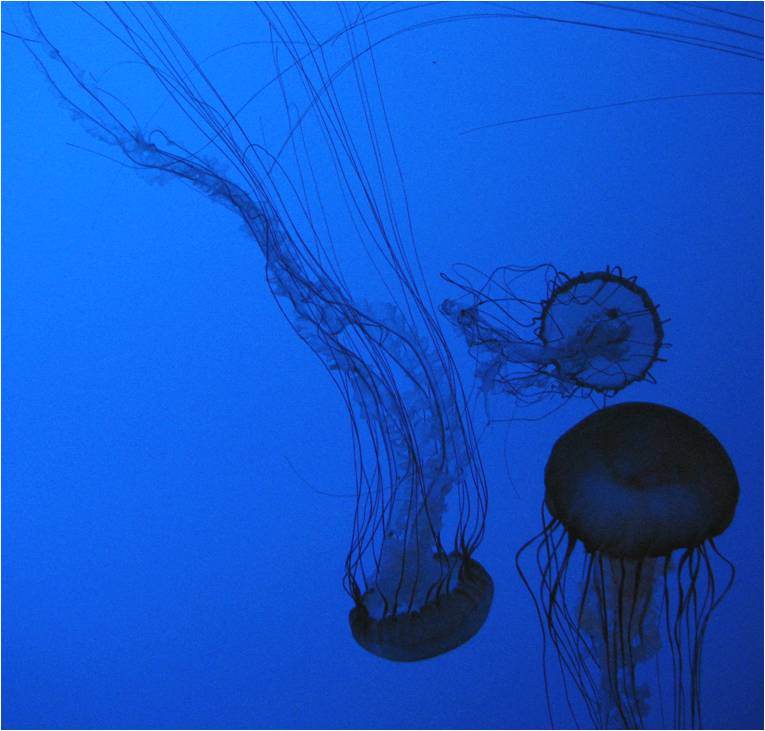
And observe the ethereal beauty of these jellyfish, which look like dance costumes painted by Degas and minus the ballerinas:


And finally, check out the eye (or maybe many eyes? or maybe something else entirely?) of this handsome tarantula, a creature that seems to me to exude a certain gravitas (which perhaps comes with the territory if you’re poisonous):


Ah, yes; there will be good days ahead…


{A note: I do write all text and take all pictures. Please do not reproduce either without my permission.}

Saturday, October 30, 2010

Creepy Crawlies

As we approach the best of all holidays, Halloween, it seems only right to help set the mood by reminding you of—or introducing you to—the world of invertebrates, whose shapes and behaviors are weirder and wilder than anything imagined in science fiction.

I don’t have pictures, unfortunately, of all of the creatures I’d like to talk about (most notably the deep-sea anglers, those gaping-jawed fish who draw prey in with a glowing, bioluminescent “lantern” suspended on a fleshy lure—and who exhibit an especially interesting kind of sex dimorphism where the male, about ten times smaller than the female, sniffs out a female in the vast emptiness of the deep sea and, in order to ensure he’ll stay with her now he’s found her, attaches himself to her and eventually merges into her body, getting food from her bloodstream and becoming a dangling, semi-parasitic sack of sperm)—but I do have a good number of photos of invertebrates, in particular marine organisms, whose fantastic lives seem quite appropriate for this supernatural season.

Take, for example, a tube worm like this one:


These creatures are segmented worms in the same phylum as earthworms; they’re called “sedentary polychaetes” (pronounced “polly-keets”), as opposed to their near relations the—I love this—“errant polychaetes,” which move around more and actively hunt for prey. Tube worms, on the other hand, build these tubes for themselves and live within them, extending beautiful fanlike bouquets of tentacles and gills in order to feed on floating particles in the water column and to breathe.

Or what about jellyfish, those creatures that seem like both aliens and UFOs in one?


Sure, they’re beautiful to look at, but remember that they’re rapacious predators: pulsing, translucent disks of light trailing streamers whose delicacy disguises their deadliness. Imagine being pursued by a being with no eyes, no head, no brain, even, just an insatiable mouth (that is also its anus) and reaching, grasping tentacles equipped with a paralyzing sting. They may look as ethereal as spirits, but their behavior is more ghoulish than ghostly.

And since Halloween is all about costumes and disguise, what about these creatures, which are always dressing up or camouflaging themselves?


Hermit crabs have a carapace that covers their head and thorax, but their delicate little abdomens are soft and naked: the perfect snack for a hungry predator. So they use the empty shells of dead snails, into which their curved abdomens fit perfectly, as protective armor. But, unlike the snails that originally made the shells, they can’t produce these from scratch or add on to them as they grow, so each time they get bigger, they need to find a new shell. Hermit crabs live in a state of perpetual conviction that somewhere nearby there is a better shell than the one they’re wearing, and they keep looking for it—even on other hermit crabs. They’re like the discontented guest at your Halloween party who keeps admiring other people’s costumes in a creepily covetous way.


And then there are spider crabs which, like the aptly named decorator crabs, pick off bits of sponges and algae and cultivate those organisms’ growth on their shells, the better to disguise themselves from predators (and maybe from prey as well).


And then there are stick insects like these, whose very articulations look more like the connections in a plant’s stem than the joints of an arthropod. (I can imagine a horror movie in which all the “leaves” on a tree are, you suddenly discover, stick insects—and like a fall tree in a windstorm, suddenly the limbs of the tree are bare and the insects rush down the trunk and converge on the hapless victims.)

And finally, of course, there is the octopus:


—that magician of the deep whose color and texture can change in an eyeblink, that Houdini who can fit through spaces the size of a keyhole, that mixture of soft, sinuous beauty, limbs like liquid, like fine silk, like the fabric of a cape flung out and left to settle in folds—and incredible strength, with muscular tentacles whose grip is strong as a cable’s; with a beak sharp as a raptor’s hidden under a flurry of suction disks.


There are many more—so many more!—but I think I’ve given you a glimpse, at least, of the diversity and magical weirdness of invertebrates. And if you haven’t picked an outfit for that party you’ve been invited to tonight, consider going as an invertebrate—a giant squid, for example, or a poisonous blue-ringed octopus. Sure, the costume might take a little work, but you’d be paying homage to the majestic, mysterious creatures of the deep—and you’d win the undying admiration of your friends.


{A note: I do write all text and take all pictures. Please do not reproduce either without my permission.}

Saturday, September 25, 2010

Impressionistic Invertebrates

I did; I stopped by the Invertebrate House this past week, even though the light in the exhibits is not very good for photography and even though I’m always tempted to correct people—even more so than in the rest of the zoo—when they relay inaccurate invertebrate information to their offspring. But it turned out to be a good day; the light was just right for a few clear shots and a number of semi-impressionistic images—and the people were not unduly uninformed.

I saw an interesting orgy of ophiuroids—not a real orgy, I don’t think, but it was definitely a big seething mass of brittle stars writhing their arms over one another. Brittle stars are related to (but different from!) starfish; their arms are connected to a central disc but are much longer and more flexible than those of starfish, hence their name: “ophios” means “snake” in ancient Greek, and their limbs do have that sinuous quality. I don’t know what they were so excited about the other day, but there was plenty of twisting around going on.


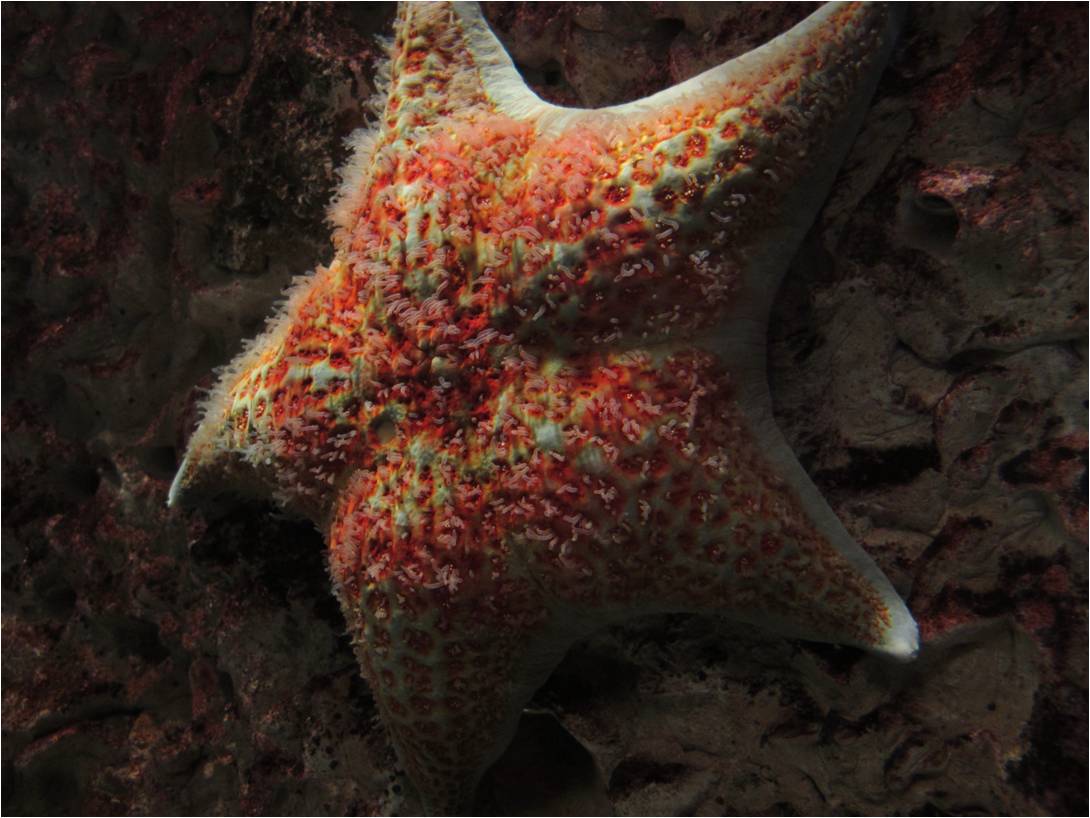
By the echinoderms (urchins, brittle stars, starfish, etc.) I made sure to take a picture of one of my favorite characteristics of that phylum, their tube feet. These are used in starfish and other echinoderms in order to move around (among other things); they’re connected to the starfish’s water vascular system and expand when water is forced into them. (They can also provide a suction force, as when a starfish is trying to pry open a scallop so that it can evert its stomach and ingest the hapless bivalve.)


I also tried to take pictures of a number of crustaceans, but I’m only happy with my images of the giant freshwater prawn, the slipper lobster, and the enormous hermit crab.


And then there was the octopus, Octavius, who was unusually active today (probably because it was nearly his feeding time) and kept “pacing” the tank, crawling along the wall with all suckers moving or stretching out over the rocks, his beautiful, immensely flexible and muscular flesh swooping over and draping onto the surface like a cape settling.


The pictures, of course, can’t do him justice, but I hope they can suggest something of the magical beauty of his movements.


{A note: I do write all text and take all pictures. Please do not reproduce either without my permission.}
Related Posts Plugin for WordPress, Blogger...