Showing posts with label octopus. Show all posts

Wednesday, August 8, 2012

Undomesticated Peeves Part 1


(Well, they can’t be “pet peeves” if they’re about wildlife, can they?)

Recently Patti Abbott posted a question on her blog asking what relatively small things annoyed her readers. Being who I am, I had to struggle to keep the list down, but one of my foremost irritations is, of course, a biology-related one.

Often—faaaar too often, in our supposedly civilized society—people confuse mammals with animals. This is not to say that mammals are not animals. However, just as all squares are rectangles but not all rectangles are squares, “animals” is a category that includes a vast array of species that are not anything like mammals (which themselves make up only a tiny percentage of the number of animals out there).

And I have to admit, I’m baffled when people say that insects or fish or octopi aren’t animals. What do they think they are—fruit?


[this mantis shrimp is having an existential crisis:
when it looks in the mirror, does it see an animal?]

This is not just a trivial thing, given that it highlights both our mammal-centric thinking (dangerous as well as profoundly inaccurate) and our general ignorance of basic zoology. Or maybe it’s not true ignorance so much as carelessness; surely if someone paused to think, he or she would realize that there is no category other than “animal” into which they could place alligators or stick insects or barnacles. But it worries me that anyone would have to pause to think about it.


Maybe I’m just being snobbish, complaining about these taxonomical inaccuracies. But—here’s the great part—I don’t care!


Don’t say that jellyfish, or fruitflies, or any other species lacking hair and mammary glands, aren’t animals. There’s just no excuse for that kind of thing.

Stay tuned for more of my education-through-harangues campaign!


{A note: I do write all text and take all pictures. Please do not reproduce either without my permission.}

Monday, August 6, 2012

Prism Break


The first kind of photography I learned to do all the way through, from taking the photos to developing the film to printing the pictures, was black-and-white photography, and for a while in college, when I had regular access to darkrooms, I was—maybe not obsessed—but certainly very taken by it. When I got into digital photography I felt I had to relearn how to use color in compositions.

Now I’m relearning how great it can be to leave color out.


I’d forgotten how much fun black-and-white photography is. I’d forgotten too how it lets you focus on texture and shape and portraiture and drama in a way that can occasionally get cluttered up by color.

For example, when photographing the howler monkey with her new(ish) baby, the absence of color helps me better frame their tender moments.


The absence of color makes the movements of the giant Pacific octopus, Pandora, as startling, sinuous, and striking as they are in real life.


It lets me enjoy the silky, liquid texture of a poison-dart frog without being distracted by its brilliant color.


I wish I could be more articulate, or more profound, but far more talented photographers than I have already done so. Suffice to say that it’s always nice to be reminded, yet again, that there are an infinite number of ways of seeing the world.

I recognize that not everyone responds to darkroom lights and fixative fumes as if they were memory- and perception-inducing madeleines. But have there been news ways in which you too have discovered the natural world?


{A note: I do write all text and take all pictures. Please do not reproduce either without my permission.}

Wednesday, January 25, 2012

Submit!


[Pandora the octopus]

Just a reminder to send your invertebrate blog-post submissions for February's Circus of the Spineless to me at squidfan@gmx.com.


{A note: I do write all text and take all pictures. Please do not reproduce either without my permission.}

Saturday, October 30, 2010

Creepy Crawlies

As we approach the best of all holidays, Halloween, it seems only right to help set the mood by reminding you of—or introducing you to—the world of invertebrates, whose shapes and behaviors are weirder and wilder than anything imagined in science fiction.

I don’t have pictures, unfortunately, of all of the creatures I’d like to talk about (most notably the deep-sea anglers, those gaping-jawed fish who draw prey in with a glowing, bioluminescent “lantern” suspended on a fleshy lure—and who exhibit an especially interesting kind of sex dimorphism where the male, about ten times smaller than the female, sniffs out a female in the vast emptiness of the deep sea and, in order to ensure he’ll stay with her now he’s found her, attaches himself to her and eventually merges into her body, getting food from her bloodstream and becoming a dangling, semi-parasitic sack of sperm)—but I do have a good number of photos of invertebrates, in particular marine organisms, whose fantastic lives seem quite appropriate for this supernatural season.

Take, for example, a tube worm like this one:


These creatures are segmented worms in the same phylum as earthworms; they’re called “sedentary polychaetes” (pronounced “polly-keets”), as opposed to their near relations the—I love this—“errant polychaetes,” which move around more and actively hunt for prey. Tube worms, on the other hand, build these tubes for themselves and live within them, extending beautiful fanlike bouquets of tentacles and gills in order to feed on floating particles in the water column and to breathe.

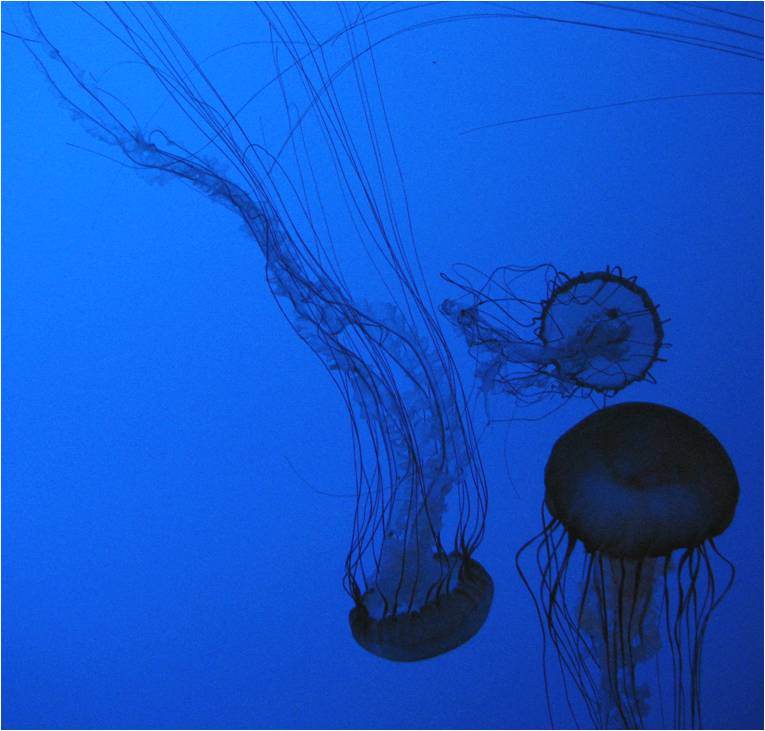
Or what about jellyfish, those creatures that seem like both aliens and UFOs in one?


Sure, they’re beautiful to look at, but remember that they’re rapacious predators: pulsing, translucent disks of light trailing streamers whose delicacy disguises their deadliness. Imagine being pursued by a being with no eyes, no head, no brain, even, just an insatiable mouth (that is also its anus) and reaching, grasping tentacles equipped with a paralyzing sting. They may look as ethereal as spirits, but their behavior is more ghoulish than ghostly.

And since Halloween is all about costumes and disguise, what about these creatures, which are always dressing up or camouflaging themselves?


Hermit crabs have a carapace that covers their head and thorax, but their delicate little abdomens are soft and naked: the perfect snack for a hungry predator. So they use the empty shells of dead snails, into which their curved abdomens fit perfectly, as protective armor. But, unlike the snails that originally made the shells, they can’t produce these from scratch or add on to them as they grow, so each time they get bigger, they need to find a new shell. Hermit crabs live in a state of perpetual conviction that somewhere nearby there is a better shell than the one they’re wearing, and they keep looking for it—even on other hermit crabs. They’re like the discontented guest at your Halloween party who keeps admiring other people’s costumes in a creepily covetous way.


And then there are spider crabs which, like the aptly named decorator crabs, pick off bits of sponges and algae and cultivate those organisms’ growth on their shells, the better to disguise themselves from predators (and maybe from prey as well).


And then there are stick insects like these, whose very articulations look more like the connections in a plant’s stem than the joints of an arthropod. (I can imagine a horror movie in which all the “leaves” on a tree are, you suddenly discover, stick insects—and like a fall tree in a windstorm, suddenly the limbs of the tree are bare and the insects rush down the trunk and converge on the hapless victims.)

And finally, of course, there is the octopus:


—that magician of the deep whose color and texture can change in an eyeblink, that Houdini who can fit through spaces the size of a keyhole, that mixture of soft, sinuous beauty, limbs like liquid, like fine silk, like the fabric of a cape flung out and left to settle in folds—and incredible strength, with muscular tentacles whose grip is strong as a cable’s; with a beak sharp as a raptor’s hidden under a flurry of suction disks.


There are many more—so many more!—but I think I’ve given you a glimpse, at least, of the diversity and magical weirdness of invertebrates. And if you haven’t picked an outfit for that party you’ve been invited to tonight, consider going as an invertebrate—a giant squid, for example, or a poisonous blue-ringed octopus. Sure, the costume might take a little work, but you’d be paying homage to the majestic, mysterious creatures of the deep—and you’d win the undying admiration of your friends.


{A note: I do write all text and take all pictures. Please do not reproduce either without my permission.}

Saturday, September 25, 2010

Impressionistic Invertebrates

I did; I stopped by the Invertebrate House this past week, even though the light in the exhibits is not very good for photography and even though I’m always tempted to correct people—even more so than in the rest of the zoo—when they relay inaccurate invertebrate information to their offspring. But it turned out to be a good day; the light was just right for a few clear shots and a number of semi-impressionistic images—and the people were not unduly uninformed.

I saw an interesting orgy of ophiuroids—not a real orgy, I don’t think, but it was definitely a big seething mass of brittle stars writhing their arms over one another. Brittle stars are related to (but different from!) starfish; their arms are connected to a central disc but are much longer and more flexible than those of starfish, hence their name: “ophios” means “snake” in ancient Greek, and their limbs do have that sinuous quality. I don’t know what they were so excited about the other day, but there was plenty of twisting around going on.


By the echinoderms (urchins, brittle stars, starfish, etc.) I made sure to take a picture of one of my favorite characteristics of that phylum, their tube feet. These are used in starfish and other echinoderms in order to move around (among other things); they’re connected to the starfish’s water vascular system and expand when water is forced into them. (They can also provide a suction force, as when a starfish is trying to pry open a scallop so that it can evert its stomach and ingest the hapless bivalve.)


I also tried to take pictures of a number of crustaceans, but I’m only happy with my images of the giant freshwater prawn, the slipper lobster, and the enormous hermit crab.


And then there was the octopus, Octavius, who was unusually active today (probably because it was nearly his feeding time) and kept “pacing” the tank, crawling along the wall with all suckers moving or stretching out over the rocks, his beautiful, immensely flexible and muscular flesh swooping over and draping onto the surface like a cape settling.


The pictures, of course, can’t do him justice, but I hope they can suggest something of the magical beauty of his movements.


{A note: I do write all text and take all pictures. Please do not reproduce either without my permission.}
Related Posts Plugin for WordPress, Blogger...