Monday, December 6, 2010

UnBearably Cute

I was taking a brisk walk along Rock Creek yesterday morning, just skirting the zoo, when I spotted the Andean bear cubs playing around in their exhibit. My brisk walk through the woods because a brisk walk into the zoo and a long time standing, enchanted, in front of their enclosure.

Early on a chilly Sunday morning, I was their only admirer. A kind zookeeper passing by called one of the cubs to approach the front of the exhibit: “Come and pose!” she said, and, by golly, the cub did!


I exclaimed about the cub’s cuteness, and she told me that he’s in fact “a terror” and a spoiled brat.


“But he’s so cute, I’m sure he gets away with it,” I said, taking pictures like mad.

“Yeah. That’s true across species, isn’t it?” she said, smiling wryly, and walked on.


(P.S. - Expect a post or two involving the winners of the Charismatic Macrofauna battle, the small-clawed otters, in the next couple of days.)


{A note: I do write all text and take all pictures. Please do not reproduce either without my permission.}

Sunday, December 5, 2010

Close Encownters

This morning I once again practiced my time-honored cow-luring technique (see my earlier post for details), and with great success!

Well, I admit I only had mild success with the alpacas.


—However, I was able to, first, engage the interest of the nearest cow, who eyed me, then approached:


And then approached a lot:


(I still have a little bit of cud smeared on the side of my camera.)

Then, the more-distant cow—the one with whom I’d had a previous bonding moment (and later an icky moment)—noticed me,


And came by to take a look:


Great days, I tell you. Great days.


{A note: I do write all text and take all pictures. Please do not reproduce either without my permission.}

Friday, December 3, 2010

Flamingo Friday: All Hail the Preen


{A note: I do write all text and take all pictures. Please do not reproduce either without my permission.}

Thursday, December 2, 2010

The Frogs Die in Earnest

I’m sure you’re all familiar with this phrase, which has been attributed to a number of sources: “Though boys throw stones at frogs in jest, the frogs do not die in jest, but in earnest.”

It’s a phrase worth remembering. Because even when we don’t do damaging things precisely “in jest”—even when, for example, we just screw up so cosmically due to negligence that people die and oil spews into the Gulf for months—even then, we seem to think that it’s just as easy for the rest of nature to forgive and forget as it is for us.

But unlike our concern about the Deepwater explosion, which dissipated quickly, the oil isn’t going away. It’s going into the bodies of animals up and down the food chain, building up in higher and higher concentrations as their bodies sequester it or as they eat other contaminated prey. It’s covering seabirds, destroying the waterproofing and insulation of their feathers, coating their throats as they try to preen themselves clean. It’s going into the mouths and noses of sea turtles breaking the surface for air.

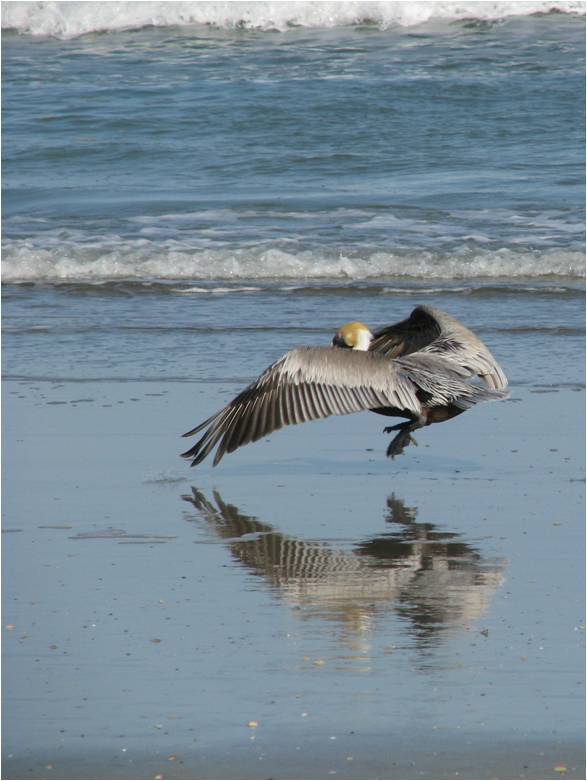
During March, I visited Cocoa Beach and the Merritt Island National Wildlife Refuge with my parents. We saw any number of amazing and beautiful birds, and one of the most enchanting sightings for me was also one of the most common—the brown pelicans that flew above and swaggered along the beaches.


They were amazing birds, handsome and comical at once, entirely charismatic, and, as my parents can attest, I spent most of our beach-time taking endless photographs of them.


Now that means that it’s easier for me to envision what these charming, self-assured birds look like bedraggled and coated in oil, unable to understand why their usual plunge for fish has covered them in this noxious substance that fouls their mouths and hardens as it dries, not knowing how to remove it or why it affects their movement and flight.

I’m not writing this to craft a horror story, although it continues to be one for countless species, and will continue to be for generations to come. I’m telling you because this is the last week to contact your Senators and insist that, during the lame-duck session, they pass an oil-spill bill that will hold BP responsible for long-term cleanup in the Gulf. Here’s an easy, pre-made letter to send your senators from Audubon:

http://www.audubonaction.org/spillbill

And here is a spill-bill “fact sheet” with more information to use in contacting senators, writing letters to the editor, or getting information out to your friends and colleagues:

Spill bill fact sheet:
http://www.audubon.org/sites/default/files/documents/spill-bill-fact-sheet-20101111.pdf

Please get involved in this. Remember that I, living in DC, don’t even have any representatives I can contact, so I need to be assured that other people, hopefully many of them, are doing something to help.


{A note: I do write all text and take all pictures unless otherwise specified. Please do not reproduce either without my permission.}

Wednesday, December 1, 2010

I’ve Got a Mantis Shrimp and I’m Not Afraid to Use It

(I hope you'll all forgive the last two days' worth of shameless self-promotion. I now return you to your regularly scheduled program...er, blog.)

On the day after Thanksgiving, our visiting relatives and we took a walk in the Zoo, where we crouched low and got alpacas to investigate us, saw small-clawed otters being adorable, and half froze in the chilly wind. We were all happy to get into the warmth of the Invertebrate House, where I tried not to pontificate too much about things like the water-vascular systems of echinoderms. As we looked into some of the smaller tanks, what should we see but a mantis shrimp! I had never seen it before, and a zoo employee informed us that it didn’t come out of its burrow very often.

In case you’re unfamiliar with them, mantis shrimp are not actually shrimp, although they do look kind of like big, extremely lengthened ones. They’re very territorial crustaceans that spend a lot of time tending to, and cleaning out, their burrows, and when other animals approach their territory they tend to lash out with a punch so violent that its force is equivalent to a .22-caliber bullet. They can even break aquarium glass, and we were told the mantis shrimp’s tank was specially reinforced.


It looked pretty mild-mannered to us, though, and very curious—but that could be its anatomy. Mantis shrimp have enormous compound eyes, each of which provides them with trinocular vision, and they can rotate these eyes independently of one another. When the mantis shrimp investigates a watching human (or their camera lens), its eyes rotate all over the place, and sometimes areas get darker or lighter; I don’t know what that’s about, but maybe there’s a pigment used for specific kinds of focusing? (Anyone who knows more about crustacean eyes than I do should jump in at any time.)


And the mantis shrimp does seem to like investigating people and things; the zoo employee (I don’t know her position) said that she’s sometimes able to lure the mantis shrimp out by putting her cell phone near the glass: it will come out to wiggle its eyes at it.

It was a fabulous sighting, not least because these crustaceans are so spectacularly colored around their eyes, chelipeds, and tail:


It also made me think about how mantis shrimp could be used in the commission of crimes: they could be weapons; they could break glass in robberies; they could serve as a distraction during a pickpocketing—the possibilities are endless.

Of course, you’d have to carry a bowl of seawater around with you, which might not help you look like an inconspicuous, innocent bystander, but I’m sure there’s a way around that. And once you figure that out, I bet a whole range of marine invertebrates could be handy criminal weapons/tools/accomplices! I’ll start making a list.


{A note: I do write all text and take all pictures. Please do not reproduce either without my permission.}
Related Posts Plugin for WordPress, Blogger...