Showing posts with label jellyfish. Show all posts

Thursday, June 19, 2014

So long, and thanks for all the shellfish


This Monday I learned, to my great dismay and regret, that on Sunday June 22 the National Zoo is closing its Invertebrate House, the only part of the zoo that highlighted the species representing 97% of all animal life and an incredible, awe-inspiring diversity of shapes, life cycles, and behaviors.

For more on the closing, you can read Gwen Pearson’s excellent post on Wired.com.

There’s nothing really to do about it except be sorry. I myself think it’s a tremendous shame that we’ve lost not just beautiful and fascinating animals but, through them, the chance to introduce the public to the enormous variation and value of species that many people don’t even realize exist.

So in preparation for the closing this weekend, in celebration of the Invertebrate House and its denizens, I’m posting a few more pictures of these astounding animals. Enjoy.

[cuttlefish; they can change their skin's texture in less than a second:]

[brittle star (related to starfish and sea urchins):]

[jellyfish:]


[sea anemones:]

[cleaner(?) shrimp on a cnidarian (maybe a soft coral?):]

[tube worm:]

[sea urchin:]

[soft coral or sea anemone:]

[mantis shrimp:]


Goodbye, all...


{A note: I do write all text and take all pictures. Please do not reproduce either without my permission.}

Wednesday, July 11, 2012

Marine Xenophilia


I’ve never made a secret of my love of all things marine, including snails, barnacles, and the sea itself. Part of the magic and mystery of the sea, to me, is that its inhabitants, existing in a medium so different from our own, have developed such incredible physiologies, physiognomies, and behaviors. That’s why, when people talk so excitedly about life on other planets, I wonder why they set their sights on such distant places and possibilities, when there are so many aliens among us, cementing themselves to intertidal rocks, living in the interstices between grains of sand, and gliding effortlessly through depths whose pressure would crush us in an instant.

So to you I pose a question: what’s your favorite marine species?


{A note: I do write all text and take all pictures. Please do not reproduce either without my permission.}

Monday, October 10, 2011

Flotsam and Jetsam (I)


This Columbus Day weekend Annie and I went again to Rehoboth Beach, DE. We saw a great deal of not-so-wild wildlife:


And we saw a fair amount of not-so-live wildlife:


[either a true jellyfish or
a ctenophore (comb jelly)]


[a fish]


[a jellyfish:
it's really most sincerely dead.]

During our seaside strolls we also observed an incident of intraspecific kleptoparasitism.

This phrase may sound complicated, but chances are, if you have siblings, you’ve either engaged in intraspecific kleptoparasitism or been a victim of it. Basically, it’s when you let somebody else of your species expend his/her energy acquiring food—and then you take it from them.

In this case, one gull (ring-billed, I think) had caught a crab, and another ring-bill dive-bombed the poor crab-catcher until s/he, harassed and distracted, dropped the crab, allowing the second gull to swoop in and grab the crustacean.


["Mwahaha."
--It seemed to say.]

Not content with having stolen the crab, the second gull added insult to injury by waving its prize in the first gull’s face (beak?). As we watched, we became convinced that the first gull was standing on its dignity, pretending indifference to its robber’s taunts.


[“Crab? What cr—oh, that crab;
I didn’t want that old thing anyway.”]

The empty-beaked gull, making an attempt at nonchalance, eventually flew away and left the second gull to its stolen meal, but we suspected that it sent a curse of indigestion on its robber’s head.


No doubt the crab did the same.


{A note: I do write all text and take all pictures. Please do not reproduce either without my permission.}

Tuesday, October 4, 2011

Bella Gad, in Memory


Bella Gad was my grandmother’s cousin (or at least that’s as close as I’ll get to being precise about family relationships). This isn’t the place in which to paint a portrait of her even if I thought I could. I will say, though, that Bella was a mixture of extremely strong—even when baseless—opinions, great humor, and tremendous affection. She also had a very good eye and an excellent artistic sense, and I was always very flattered that she was such an enthusiastic supporter of my photography—not just the photos of animals looking winsome, but those in which I tried to frame things differently, to focus on form or abstraction or try a new perspective.


Bella lived in Israel and, although she spoke several languages, didn’t speak English; she and I wrote to each other in mutually half-forgotten French, resorting regularly to the dictionary. Several times a year, I would send her an “album,” a collection of my photos with brief captions in my scant French.

I was only starting to think about which photos I would include in an album this fall when I learned that she had died last week. These are some of the photos I would have included in that album. I wish she could see them.


Tu me manques, Bella.


{A note: I do write all text and take all pictures. Please do not reproduce either without my permission.}

Tuesday, August 2, 2011

This Post Has No Redeeming Social or Intellectual Value


Look! Moon Jellyfish!


{A note: I do write all text and take all pictures. Please do not reproduce either without my permission.}

Sunday, May 15, 2011

Danse Medusae


I studied marine biology, and so I know that jellyfish are not intellectually sophisticated. In fact, they have no intellect at all, since they lack brains entirely. They do have a “nerve net” of interconnected cells, and some have cells that relate to sensory abilities like sight—of a sort—and smell and touch, but that’s as much as you’ll get; no jellyfish is going to compose this century’s Mrs. Dalloway. Maybe an American Idol spin-off, but that’s about it.

Jellyfish also, as far as I’m aware, don’t really have any sort of social network or group behaviors. That is, they do occasionally travel in vast swarms (some of which are becoming more prevalent as a result of global warming—see this pop-sci briefing or this scientific review for more details)—but they’re not doing things with each other so much as alongside one another. As far as modern science can judge, they don’t have love affairs or jealousies, grand ambitions or dark schemes.


So there’s absolutely no reason why they should have this aura of mystery, the grace of a dedicated and passionate ballet dancer, the suggestion of ghostly wistfulness like a phantom returning from the afterlife to visit a lost love or right a wrong.

Their relatives, anemones and coral, beautiful as they can be, don’t prompt these leaps of the heart or inspire imaginings of an internal, emotional life worthy of Tchaikovsky. Is it their gauzy, drifting movement that does it, that convinces us they must be buoyed by a delight in their own delicacy, by the joy of floating dreamily on the currents?


It’s the only explanation I can come up with. But I have to admit that I haven’t thought about it in too much depth; I’m too busy taking pleasure in their movements, and the thoughts they conjure, myself.


{A note: I do write all text and take all pictures. Please do not reproduce either without my permission.}

Sunday, March 13, 2011

...and You, Sir, Are No Gentleman

[also not a gentleman but a cuttlefish]

I would be among the first to agree that what you call someone matters—a fact that should not surprise any of you who have read my rants about people calling orangutans “monkeys” or referring to every single animal they see as a “he.” On the other hand, when a term already exists in common parlance, it strikes me as absurd, not to mention pretentious, to suddenly alter that common name and make the usage of it a measure of how smart or well-informed someone is.

What am I talking about, you ask?

Here’s an example. A few years ago the New England Aquarium set up a very nice new exhibit all about, and full of, jellyfish—both true cnidarians and other animals that are transparent and float around in the plankton. They called the exhibit “Amazing Jellies.” –That’s right: not “jellyfish,” but “jellies,” as if they were showing off an especially impressive array of marmalades. It’s part of a new trend, calling jellyfish “jellies” and starfish “sea stars”—because, you see, they’re not really fish, so why call them that? It’s just too ignorant for words.


This drives me crazy. I mean, there’s already enough of a divide between zoologists and people who aren’t trained in science, and already enough scientific names and jargon that’s incomprehensible to the public—why alienate them over common names, too? Why make that be an indication of whether you’re really in-the-know about marine life or not? Of course they’re not fish, but then, neither are cuttlefish—should we call them “cuttles”? Should we no longer call seahorses “seahorses” because they’re not actually horses? Or change the name of sea cucumbers because they’re not related to zucchini? Or get rid of the name “Portuguese man-o’-war” altogether because, hell, that doesn’t suggest sea-life at all?

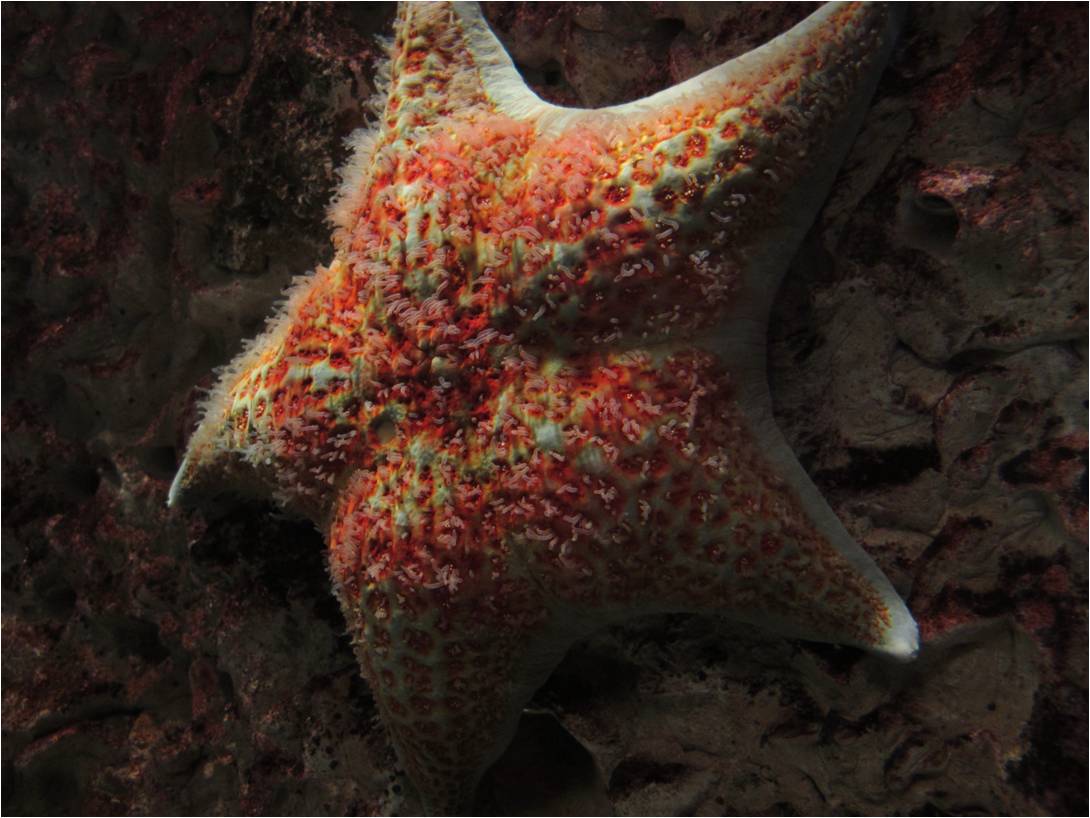
[side view of a sunflower star(fish);
doesn't it look like a volcano
with lava streaking out from it?]

If people are going to think that cuttlefish are fish, then you need to make sure they’re informed about what cuttlefish are. I don’t think anyone was in danger of considering a starfish to be a fish—and if they were, I doubt a name change would do anything to correct that impression. Why not work on actual education, rather than futzing around with names? The only people who are changing what they call these organisms already know what they are.

What worries me even more is that this campaign won’t stop at “fish” suffixes but really will try to alter other common names like the ones I’ve listed above, thus eliminating poetry as well as accessibility from what we name organisms. And that’s a terrible shame. It’s so much better to appreciate the name “leafy sea dragon” (which is a kind of dramatically ornamented seahorse) and learn, or teach, more about the animal itself than to try to make its common name duller.

[a leafy sea dragon;
its head is to the right]

Maybe once we get that through our heads we’ll be better educators as well as researchers.


{A note: I do write all text and take all pictures. Please do not reproduce either without my permission.}

Tuesday, January 4, 2011

Through a Glass Brightly

I recently got a new camera—not to replace my main camera, mind you (which unfortunately is acting as if it wants to be replaced, but that’s another story), but just as a good, smaller alternative for certain situations, like those with low light. And I have to tell you that you’ll be seeing many more photos from the Invertebrate House and other indoor exhibits now, because I love the amount of detail and color it captures in those dark places. This post is basically just an excuse to show you some photos I took of organisms in aquaria and terraria, but I promise I’ll get over my photographic excitement and write some more substantial commentary soon.

But for the moment—get a load of this mantis shrimp!


And how lovely are the colors on this enormous hermit crab, which seemed to be wondering whether I had a better shell for it concealed on my person?


And observe the ethereal beauty of these jellyfish, which look like dance costumes painted by Degas and minus the ballerinas:


And finally, check out the eye (or maybe many eyes? or maybe something else entirely?) of this handsome tarantula, a creature that seems to me to exude a certain gravitas (which perhaps comes with the territory if you’re poisonous):


Ah, yes; there will be good days ahead…


{A note: I do write all text and take all pictures. Please do not reproduce either without my permission.}
Related Posts Plugin for WordPress, Blogger...