As we approach the best of all holidays, Halloween, it seems only right to help set the mood by reminding you of—or introducing you to—the world of invertebrates, whose shapes and behaviors are weirder and wilder than anything imagined in science fiction.
I don’t have pictures, unfortunately, of all of the creatures I’d like to talk about (most notably the deep-sea anglers, those gaping-jawed fish who draw prey in with a glowing, bioluminescent “lantern” suspended on a fleshy lure—and who exhibit an especially interesting kind of sex dimorphism where the male, about ten times smaller than the female, sniffs out a female in the vast emptiness of the deep sea and, in order to ensure he’ll stay with her now he’s found her, attaches himself to her and eventually merges into her body, getting food from her bloodstream and becoming a dangling, semi-parasitic sack of sperm)—but I do have a good number of photos of invertebrates, in particular marine organisms, whose fantastic lives seem quite appropriate for this supernatural season.
Take, for example, a tube worm like this one:

These creatures are segmented worms in the same phylum as earthworms; they’re called “sedentary polychaetes” (pronounced “polly-keets”), as opposed to their near relations the—I love this—“errant polychaetes,” which move around more and actively hunt for prey. Tube worms, on the other hand, build these tubes for themselves and live within them, extending beautiful fanlike bouquets of tentacles and gills in order to feed on floating particles in the water column and to breathe.
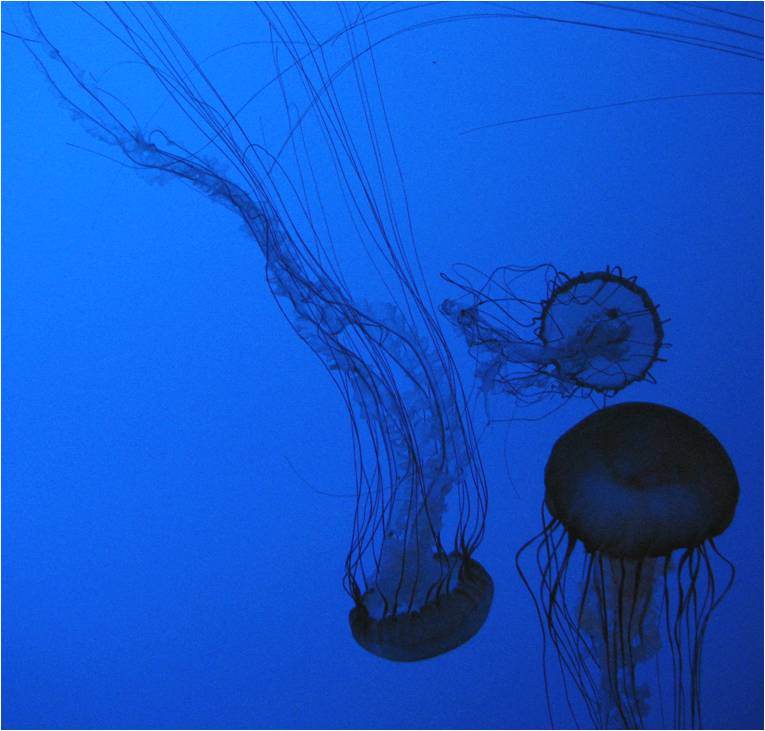
Or what about jellyfish, those creatures that seem like both aliens and UFOs in one?

Sure, they’re beautiful to look at, but remember that they’re rapacious predators: pulsing, translucent disks of light trailing streamers whose delicacy disguises their deadliness. Imagine being pursued by a being with no eyes, no head, no brain, even, just an insatiable mouth (that is also its anus) and reaching, grasping tentacles equipped with a paralyzing sting. They may look as ethereal as spirits, but their behavior is more ghoulish than ghostly.
And since Halloween is all about costumes and disguise, what about these creatures, which are always dressing up or camouflaging themselves?

Hermit crabs have a carapace that covers their head and thorax, but their delicate little abdomens are soft and naked: the perfect snack for a hungry predator. So they use the empty shells of dead snails, into which their curved abdomens fit perfectly, as protective armor. But, unlike the snails that originally made the shells, they can’t produce these from scratch or add on to them as they grow, so each time they get bigger, they need to find a new shell. Hermit crabs live in a state of perpetual conviction that somewhere nearby
there is a better shell than the one they’re wearing, and they keep looking for it—even on other hermit crabs. They’re like the discontented guest at your Halloween party who keeps admiring other people’s costumes in a creepily covetous way.

And then there are spider crabs which, like the aptly named decorator crabs, pick off bits of sponges and algae and cultivate those organisms’ growth on their shells, the better to disguise themselves from predators (and maybe from prey as well).

And then there are stick insects like these, whose very articulations look more like the connections in a plant’s stem than the joints of an arthropod. (I can imagine a horror movie in which all the “leaves” on a tree are, you suddenly discover, stick insects—and like a fall tree in a windstorm, suddenly the limbs of the tree are bare and the insects rush down the trunk and converge on the hapless victims.)
And finally, of course, there is the octopus:

—that magician of the deep whose color and texture can change in an eyeblink, that Houdini who can fit through spaces the size of a keyhole, that mixture of soft, sinuous beauty, limbs like liquid, like fine silk, like the fabric of a cape flung out and left to settle in folds—and incredible strength, with muscular tentacles whose grip is strong as a cable’s; with a beak sharp as a raptor’s hidden under a flurry of suction disks.

There are many more—
so many more!—but I think I’ve given you a glimpse, at least, of the diversity and magical weirdness of invertebrates. And if you haven’t picked an outfit for that party you’ve been invited to tonight, consider going as an invertebrate—a giant squid, for example, or a poisonous blue-ringed octopus. Sure, the costume might take a little work, but you’d be paying homage to the majestic, mysterious creatures of the deep—and you’d win the undying admiration of your friends.